Insight recipes
An insight is a card on the Insights screen: a name, a color, an icon and an SQL query that returns an amount for the month displayed (see Features and Web portal). This page gathers recipes ready to copy into the add-insight window (administrators): for each one, what it shows, the query and how to read the result.
All the queries on this page are checked by Carbure's tests: they follow the rules below and run against a test database, with the expected result.
Query rules
The server rejects a query that does not follow them (the add window says so while you type):
- a single
SELECTstatement, of 500 characters at most (spaces and line breaks included), with no;in the middle, no comment (--,#,/* */) and no backslash (\);WITHis not accepted, a subquery in theFROMis; - it returns a column named
amount(… AS amount): only the first row is read; {month}and{year}are replaced by the month (1 to 12) and the year displayed, as numbers;- forbidden words, even inside a quoted string: writes (
INSERT,UPDATE,DELETE,CREATE,DROP…),SET,DO,INTO,LOAD,SLEEP,BENCHMARK,SHOW,CALL,LOCK,USER,PASSWORD… (full list insrc/resources/Insight.php); theusercolumn of transactions therefore cannot be read; - only the budget tables can be read:
bank_transaction,bank_transaction_category,bank_transaction_category_keyword(categorization rules),budget,bank_accountandbank_backend(bank connections), with no database name in front (carbure.bank_transactionis rejected). Any other table is rejected: users, two-factor authentication, tokens, devices, OAuth, settings, insights, migrations… as well as the system schemas (mysql,information_schema,performance_schema,sys). The name of a rejected table is forbidden anywhere in the query, even inside a quoted string; - the query runs in a read-only transaction, in 5 seconds at most: beyond that, the server interrupts it (the add window says so, the card shows 0,00 €). It runs every time the Insights tab is displayed, and twelve times for a year's history: avoid Cartesian products.
The name has 1 to 20 characters; the color is one of 13 colors:
red, orange, amber, lime, green, teal, cyan, blue, indigo, purple,
pink, brown, gray. The icon (optional) is a Material icon chosen in the
add window.
Displaying the result
The card always shows the absolute value of the amount, with two decimals and the
€ symbol, in red if the amount is negative. There is no other format:
- a percentage or a count (of transactions, of months…) is also shown with
€: a savings rate of 32.5% appears as "32,50 €". The recipes concerned say so in their name (%, "Nb") to remove any ambiguity; - the sign only shows through the color: an expense (negative amount) is red, an income or a favorable difference is not. The recipes follow the transaction convention: negative = money going out;
- a query that returns nothing (
NULL, for example no transaction that month) or that fails shows 0,00 €; - the month-by-month history (
GET /budget/insights/history, used by the iPhone app) runs the same query for each month of the year.
Data landmarks
The useful tables (see Data model):
| Table | Useful columns |
|---|---|
bank_transaction |
date (debit date, the one of the month displayed), rdate (actual transaction date: day of a card payment), type, label, category, amount (negative = debit), pointed (1 = checked), bank_name, account_number |
bank_transaction_category |
id, name, parent_category (0 = main category), type: DEBIT, CREDIT or HORS-BUDGET |
budget |
category, amount (planned positive amount), date (first day of the month) |
bank_account |
bank_name, account_number, label (name given to the account) |
Transaction types (bank_transaction.type, woob codes, also inferred from the label
for an imported statement):
| Code | Type | Code | Type |
|---|---|---|---|
| 0 | Unknown | 6 | ATM withdrawal |
| 1 | Transfer | 7 | Card |
| 2 | Direct debit | 8 | Expense (loan repayment) |
| 3 | Check | 9 | Commissions, bank fees |
| 4 | Check deposit | 12 | Deferred debit card |
| 5 | Refund |
A few expressions come up again and again in the recipes:
- budget expenses:
amount < 0 AND category NOT IN (SELECT id FROM bank_transaction_category WHERE type = 'HORS-BUDGET' AND id <> 0)excludes off-budget categories (savings, internal transfers) but keeps uncategorized transactions (category 0); - first day of the month displayed:
MAKEDATE({year}, 1) + INTERVAL {month} - 1 MONTH;- 2 MONTHgives the previous month,MONTHthe next month. Adate >= … AND date < …filter covers a period of several months, even one spanning two years; - a category by its name rather than by its number (which changes from one instance to
another):
(SELECT id FROM bank_transaction_category WHERE name = 'Courses'). The comparison ignores case and accents. The names used here are those of the French starter pack: adapt them to yours.
Spending
A category and its subcategories
The spending of a main category, subcategories included (here "Alimentation", food: groceries, bakery, restaurants). Replace the name to track housing, transport, leisure…
SELECT SUM(t.amount) AS amount
FROM bank_transaction t
JOIN bank_transaction_category c ON c.id = t.category
WHERE 'Alimentation' IN (c.name, (SELECT p.name FROM bank_transaction_category p WHERE p.id = c.parent_category))
  AND MONTH(t.date) = {month} AND YEAR(t.date) = {year}
- Name:
Alimentation— colorgreen, iconrestaurant - Reading: negative (red), in euros; refunds in the category are deducted.
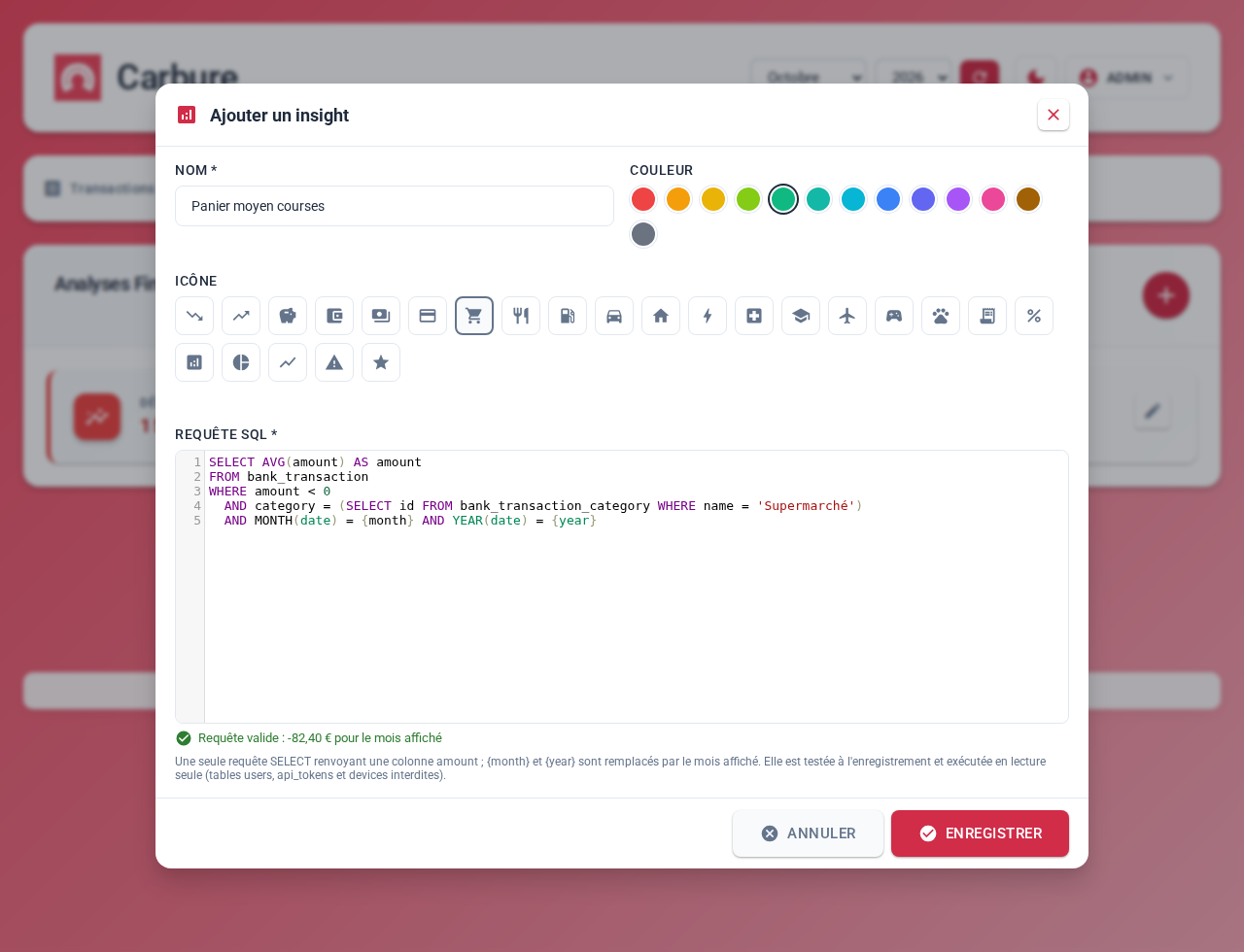
Average grocery basket
The average amount of a trip to the checkout: useful to see the effect of inflation or of switching stores, regardless of the number of trips.
SELECT AVG(amount) AS amount
FROM bank_transaction
WHERE amount < 0
  AND category = (SELECT id FROM bank_transaction_category WHERE name = 'Courses')
  AND MONTH(date) = {month} AND YEAR(date) = {year}
- Name:
Panier moyen courses— colorgreen, iconshopping_cart - Reading: negative, in euros per purchase.
A merchant
Everything paid to a merchant, whatever its category, by a word in the
label (here Amazon). LIKE ignores case; % stands for any sequence of
characters.
SELECT SUM(amount) AS amount
FROM bank_transaction
WHERE label LIKE '%AMAZON%'
  AND MONTH(date) = {month} AND YEAR(date) = {year}
- Name:
Amazon— colororange, iconshopping_cart - Reading: negative, in euros, net of the merchant's refunds.
Food delivery
Several merchants for the same use, here home delivery: an item that grows fast without you noticing.
SELECT SUM(amount) AS amount
FROM bank_transaction
WHERE (label LIKE '%UBER EATS%' OR label LIKE '%DELIVEROO%')
  AND MONTH(date) = {month} AND YEAR(date) = {year}
- Name:
Livraison repas— colorpink, iconrestaurant - Reading: negative, in euros.
Recurring direct debits
The month's direct debits whose same label was already debited the previous month: subscriptions, energy, insurance, phone. This is the household's "fixed cost", worth reviewing from time to time.
SELECT SUM(t.amount) AS amount
FROM bank_transaction t
WHERE t.type = 2 AND t.amount < 0
  AND MONTH(t.date) = {month} AND YEAR(t.date) = {year}
  AND EXISTS (SELECT 1 FROM bank_transaction p WHERE p.type = 2 AND p.label = t.label
    AND p.date >= MAKEDATE({year}, 1) + INTERVAL {month} - 2 MONTH
    AND p.date < MAKEDATE({year}, 1) + INTERVAL {month} - 1 MONTH)
- Name:
Prélèv. récurrents— colorindigo, iconreceipt_long - Reading: negative, in euros. A direct debit whose label changes every month (invoice number, date) is not recognized as recurring.
Weekend spending
Expenses made on a Saturday or a Sunday, based on the actual transaction date
(rdate): outings, Saturday groceries, impulse purchases.
SELECT SUM(amount) AS amount
FROM bank_transaction
WHERE amount < 0
  AND category NOT IN (SELECT id FROM bank_transaction_category WHERE type = 'HORS-BUDGET' AND id <> 0)
  AND DAYOFWEEK(rdate) IN (1, 7)
  AND MONTH(date) = {month} AND YEAR(date) = {year}
- Name:
Dépenses week-end— colorcyan, iconsports_esports - Reading: negative, in euros (
DAYOFWEEK: 1 = Sunday, 7 = Saturday).
Share of weekend spending
The same thing as a percentage of the month's spending: a weekend counts for 2 days out of 7, about 29%; a share well above that points to expensive weekends.
SELECT 100 * SUM(IF(DAYOFWEEK(rdate) IN (1, 7), amount, 0)) / SUM(amount) AS amount
FROM bank_transaction
WHERE amount < 0
  AND category NOT IN (SELECT id FROM bank_transaction_category WHERE type = 'HORS-BUDGET' AND id <> 0)
  AND MONTH(date) = {month} AND YEAR(date) = {year}
- Name:
Part week-end %— colorcyan, iconpercent - Reading: positive, as a percentage (shown as "27,55 €" for 27.55%).
Share paid by card
The percentage of spending paid by card (immediate or deferred debit), the rest being direct debits, transfers or withdrawals: "everyday" spending versus fixed costs.
SELECT 100 * SUM(IF(type IN (7, 12), amount, 0)) / SUM(amount) AS amount
FROM bank_transaction
WHERE amount < 0
  AND category NOT IN (SELECT id FROM bank_transaction_category WHERE type = 'HORS-BUDGET' AND id <> 0)
  AND MONTH(date) = {month} AND YEAR(date) = {year}
- Name:
Part carte %— colorblue, iconcredit_card - Reading: positive, as a percentage.
Number of withdrawals
The number of cash withdrawals in the month (the starter pack already gives the amount): many small withdrawals mean as many expenses that Carbure will not be able to categorize.
SELECT COUNT(*) AS amount
FROM bank_transaction
WHERE type = 6
  AND MONTH(date) = {month} AND YEAR(date) = {year}
- Name:
Nb retraits— colorgray, iconaccount_balance_wallet - Reading: positive, a count (shown as "3,00 €" for 3 withdrawals).
Biggest item of the month
The amount of the month's most expensive category (or subcategory), excluding uncategorized. An insight only returns a number: the item's name can be read in the Budget tab.
SELECT MIN(total) AS amount
FROM (SELECT SUM(amount) AS total FROM bank_transaction
  WHERE category <> 0
    AND category NOT IN (SELECT id FROM bank_transaction_category WHERE type = 'HORS-BUDGET')
    AND MONTH(date) = {month} AND YEAR(date) = {year}
  GROUP BY category) x
- Name:
Plus gros poste— colorred, iconpie_chart - Reading: negative, in euros.
Spending of one account
The spending of a single account, designated by the name given to it in the Accounts tab (here "Compte joint", joint account): useful when the household has a shared account and personal accounts.
SELECT SUM(amount) AS amount
FROM bank_transaction
WHERE amount < 0
  AND account_number IN (SELECT account_number FROM bank_account WHERE label = 'Compte joint')
  AND MONTH(date) = {month} AND YEAR(date) = {year}
- Name:
Compte joint— colorteal, iconhome - Reading: negative, in euros, savings and transfers included (add the budget expenses filter to exclude them).
Comparisons
Change from the previous month
The change in spending as a percentage (the starter pack gives the difference in euros): +10% means 10% more spending than the previous month.
SELECT 100 * (SUM(IF(MONTH(date) = {month}, amount, 0)) / SUM(IF(MONTH(date) = {month}, 0, amount)) - 1) AS amount
FROM bank_transaction
WHERE amount < 0
  AND category NOT IN (SELECT id FROM bank_transaction_category WHERE type = 'HORS-BUDGET' AND id <> 0)
  AND date >= MAKEDATE({year}, 1) + INTERVAL {month} - 2 MONTH
  AND date < MAKEDATE({year}, 1) + INTERVAL {month} MONTH
- Name:
Variation vs M-1 %— colorcyan, iconanalytics - Reading: as a percentage; positive (normal color) = more spending, negative (red) = less spending. Note that the color is inverted here relative to the "good / bad" meaning.
Difference from the same month last year
The month's spending minus that of the same month of the previous year: the right comparison for seasonal expenses (heating, back to school, vacations).
SELECT SUM(IF(YEAR(date) = {year}, amount, -amount)) AS amount
FROM bank_transaction
WHERE amount < 0
  AND category NOT IN (SELECT id FROM bank_transaction_category WHERE type = 'HORS-BUDGET' AND id <> 0)
  AND MONTH(date) = {month} AND YEAR(date) IN ({year}, {year} - 1)
- Name:
Écart vs N-1— colorpurple, iconshow_chart - Reading: in euros; negative (red) = more spending than last year, positive = less.
Difference from the average of the last 3 months
The month's spending minus the average of the previous 3 months: less sensitive than a
comparison with a single exceptional month. For 6 months, replace / 3 with / 6 and
- 4 MONTH with - 7 MONTH.
SELECT SUM(IF(date >= MAKEDATE({year}, 1) + INTERVAL {month} - 1 MONTH, amount, -amount / 3)) AS amount
FROM bank_transaction
WHERE amount < 0
  AND category NOT IN (SELECT id FROM bank_transaction_category WHERE type = 'HORS-BUDGET' AND id <> 0)
  AND date >= MAKEDATE({year}, 1) + INTERVAL {month} - 4 MONTH
  AND date < MAKEDATE({year}, 1) + INTERVAL {month} MONTH
- Name:
Écart vs moy. 3 mois— coloramber, iconanalytics - Reading: in euros; negative (red) = a month with more spending than usual.
Year to date
The year's spending up to and including the month displayed: to compare with an annual budget.
SELECT SUM(amount) AS amount
FROM bank_transaction
WHERE amount < 0
  AND category NOT IN (SELECT id FROM bank_transaction_category WHERE type = 'HORS-BUDGET' AND id <> 0)
  AND YEAR(date) = {year} AND MONTH(date) <= {month}
- Name:
Cumul depuis janvier— colorred, icontrending_down - Reading: negative, in euros.
12-month monthly average
The average spending per month over the 12 months ending with the month displayed: the household's standard of living, smoothed of exceptional expenses.
SELECT SUM(amount) / 12 AS amount
FROM bank_transaction
WHERE amount < 0
  AND category NOT IN (SELECT id FROM bank_transaction_category WHERE type = 'HORS-BUDGET' AND id <> 0)
  AND date >= MAKEDATE({year}, 1) + INTERVAL {month} - 12 MONTH
  AND date < MAKEDATE({year}, 1) + INTERVAL {month} MONTH
- Name:
Moyenne 12 mois— colorteal, iconshow_chart - Reading: negative, in euros per month. During the first year of use, months without data count as zero and bring the average down.
Savings and safety cushion
Savings rate
The share of the month's income that was not spent: (income + expenses) / income, excluding off-budget categories. A common benchmark is to aim for 10 to 20%.
SELECT 100 * SUM(amount) / SUM(IF(amount > 0, amount, 0)) AS amount
FROM bank_transaction
WHERE category NOT IN (SELECT id FROM bank_transaction_category WHERE type = 'HORS-BUDGET' AND id <> 0)
  AND MONTH(date) = {month} AND YEAR(date) = {year}
- Name:
Taux d'épargne %— colorpurple, iconsavings - Reading: as a percentage; negative (red) = a month spent beyond income. Empty (0,00) with no income that month.
Savings deposited
The month's deposits into savings: the "Épargne" (savings) category and its subcategories (savings accounts, life insurance). The starter pack offers the same thing by category numbers.
SELECT -SUM(t.amount) AS amount
FROM bank_transaction t
JOIN bank_transaction_category c ON c.id = t.category
WHERE 'Épargne' IN (c.name, (SELECT p.name FROM bank_transaction_category p WHERE p.id = c.parent_category))
  AND MONTH(t.date) = {month} AND YEAR(t.date) = {year}
- Name:
Épargne versée— colorpurple, iconsavings - Reading: positive = money set aside (the sign is inverted by the
-SUM); negative (red) = more withdrawals than deposits.
Safety cushion (6 months)
The spending of the 6 full months preceding the month displayed, as a positive amount: the order of magnitude of the emergency savings to keep available. The current month is not counted, so that the value does not move as the month goes by.
SELECT -SUM(amount) AS amount
FROM bank_transaction
WHERE amount < 0
  AND category NOT IN (SELECT id FROM bank_transaction_category WHERE type = 'HORS-BUDGET' AND id <> 0)
  AND date >= MAKEDATE({year}, 1) + INTERVAL {month} - 7 MONTH
  AND date < MAKEDATE({year}, 1) + INTERVAL {month} - 1 MONTH
- Name:
Matelas 6 mois— colorlime, iconsavings - Reading: positive, in euros.
Months of spending covered
How many months of spending the savings deposited since the start of the data would cover, at the average pace of the last 6 full months. Carbure does not know the balance of the savings accounts (nor the interest, nor savings made before the first sync): it is a trend indicator, not a net worth.
SELECT SUM(IF('Épargne' IN (c.name, p.name), -t.amount, 0)) / SUM(IF(t.amount < 0 AND (c.type <> 'HORS-BUDGET' OR c.id = 0)
  AND t.date >= MAKEDATE({year}, 1) + INTERVAL {month} - 7 MONTH, -t.amount / 6, 0)) AS amount
FROM bank_transaction t
JOIN bank_transaction_category c ON c.id = t.category
JOIN bank_transaction_category p ON p.id = c.parent_category
WHERE t.date < MAKEDATE({year}, 1) + INTERVAL {month} - 1 MONTH
- Name:
Matelas en mois— colorlime, iconstar - Reading: positive, a number of months ("3,60 €" = 3.6 months). A common benchmark is 3 to 6 months.
Projected end-of-month spending
The month's spending extrapolated at the current pace: 600 € spent by the 10th of a 30-day month gives 1 800 €. For a past month, it is simply the month's spending.
SELECT SUM(amount) * DAY(LAST_DAY(MAKEDATE({year}, 1) + INTERVAL {month} - 1 MONTH))
  / IF(YEAR(CURDATE()) = {year} AND MONTH(CURDATE()) = {month}, DAY(CURDATE()), DAY(LAST_DAY(MAKEDATE({year}, 1) + INTERVAL {month} - 1 MONTH))) AS amount
FROM bank_transaction
WHERE amount < 0
  AND category NOT IN (SELECT id FROM bank_transaction_category WHERE type = 'HORS-BUDGET' AND id <> 0)
  AND MONTH(date) = {month} AND YEAR(date) = {year}
- Name:
Dépenses projetées— colororange, icontrending_down - Reading: negative, in euros. Fixed direct debits at the start of the month inflate the projection in the first days.
Budget
Budgets are entered in the Budget tab, per category and per month; a category's spending includes that of its subcategories. If you set a budget on both a category and its subcategories, their spending is counted twice in these recipes.
Remaining budget
What is left to spend across all of the month's spending budgets (budgets minus spending of the budgeted categories).
SELECT SUM(b.amount + (SELECT IFNULL(SUM(t.amount), 0) FROM bank_transaction t
    JOIN bank_transaction_category c ON c.id = t.category
    WHERE (c.id = b.category OR c.parent_category = b.category)
      AND MONTH(t.date) = {month} AND YEAR(t.date) = {year})) AS amount
FROM budget b
JOIN bank_transaction_category bc ON bc.id = b.category
WHERE bc.type = 'DEBIT' AND MONTH(b.date) = {month} AND YEAR(b.date) = {year}
- Name:
Budget restant— colorblue, iconaccount_balance_wallet - Reading: in euros; positive = remaining margin, negative (red) = budgets exceeded overall (an overrun can be offset by a category under its budget).
Categories over budget
The number of categories whose spending for the month exceeds the budget (the starter pack gives the total amount of overruns).
SELECT COUNT(*) AS amount
FROM budget b
WHERE MONTH(b.date) = {month} AND YEAR(b.date) = {year}
  AND b.amount + (SELECT IFNULL(SUM(t.amount), 0) FROM bank_transaction t
    JOIN bank_transaction_category c ON c.id = t.category
    WHERE (c.id = b.category OR c.parent_category = b.category)
      AND MONTH(t.date) = {month} AND YEAR(t.date) = {year}) < 0
- Name:
Catégories dépassées— colorred, iconwarning - Reading: positive, a count of categories.
Budget used
The percentage of all spending budgets already used: to compare with how far into the month you are (50% on the 15th).
SELECT -100 * SUM((SELECT IFNULL(SUM(t.amount), 0) FROM bank_transaction t
    JOIN bank_transaction_category c ON c.id = t.category
    WHERE (c.id = b.category OR c.parent_category = b.category)
      AND MONTH(t.date) = {month} AND YEAR(t.date) = {year})) / SUM(b.amount) AS amount
FROM budget b
JOIN bank_transaction_category bc ON bc.id = b.category
WHERE bc.type = 'DEBIT' AND MONTH(b.date) = {month} AND YEAR(b.date) = {year}
- Name:
Budget consommé %— coloramber, iconpie_chart - Reading: positive, as a percentage; above 100, the budgets are exceeded.
Data quality
Uncategorized transactions
The number of the month's transactions without a category (the starter pack gives their amount): each one is a categorization rule to create.
SELECT COUNT(*) AS amount
FROM bank_transaction
WHERE category = 0
  AND MONTH(date) = {month} AND YEAR(date) = {year}
- Name:
Nb non catégorisées— colororange, iconwarning - Reading: positive, a count of transactions; the goal is 0.
Unchecked transactions
The number of the month's transactions that nobody has checked yet ("checked" box in the Transactions tab).
SELECT COUNT(*) AS amount
FROM bank_transaction
WHERE pointed = 0
  AND MONTH(date) = {month} AND YEAR(date) = {year}
- Name:
Nb non vérifiées— coloramber, iconreceipt_long - Reading: positive, a count of transactions.
Bank fees for the year
Bank fees since January (card fees, commissions, overdraft interest), by type or by category: to compare with other banks' offers.
SELECT SUM(amount) AS amount
FROM bank_transaction
WHERE (type = 9 OR category = (SELECT id FROM bank_transaction_category WHERE name = 'Frais bancaires'))
  AND YEAR(date) = {year} AND MONTH(date) <= {month}
- Name:
Frais de l'année— colorbrown, iconaccount_balance_wallet - Reading: negative, in euros.
Refunds received
The month's refunds (health, returned purchases…), by type or by category: to check that an expected refund has arrived.
SELECT SUM(amount) AS amount
FROM bank_transaction
WHERE amount > 0
  AND (type = 5 OR category = (SELECT id FROM bank_transaction_category WHERE name = 'Remboursements'))
  AND MONTH(date) = {month} AND YEAR(date) = {year}
- Name:
Remboursements— colorgreen, iconpayments - Reading: positive, in euros.
Possible duplicates
The number of pairs of the month's transactions with the same label and the same amount, less than 3 days apart: a payment debited twice, or a statement imported on top of the sync.
SELECT COUNT(*) AS amount
FROM bank_transaction a
JOIN bank_transaction b ON b.id > a.id AND b.amount = a.amount AND b.label = a.label
  AND ABS(DATEDIFF(b.date, a.date)) <= 3
WHERE MONTH(a.date) = {month} AND YEAR(a.date) = {year}
- Name:
Doublons possibles— colorred, iconwarning - Reading: positive, a count of pairs; two genuine identical purchases (two baguettes on the same day) are counted too.
What an insight cannot show
- A text: an insight returns a number, not the name of a merchant or a category (the "biggest item" gives its amount, not its name).
- Several values: one card, one value per month; for a breakdown, see the Budget and Trends tabs.
- A percentage or a count without
€: the unit is always the euro when displayed (see Displaying the result). - The spending of one person in the household: the model is shared by the household and the word
USERis forbidden; filter by account instead (see Spending of one account). - Account balances: Carbure records transactions, not balances.